

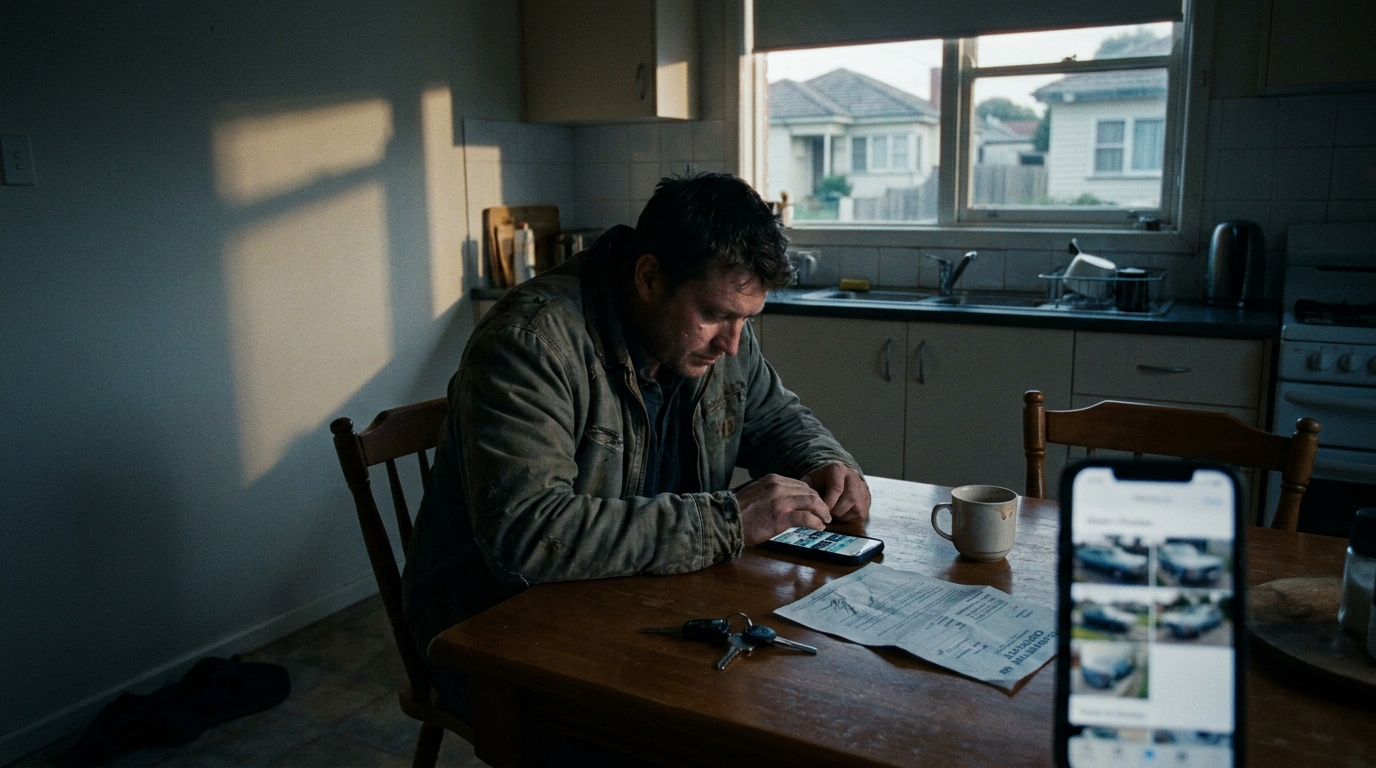
Short answer: no. There is no law in Australia that requires you to label a car listing photo as AI edited, and no marketplace used by Australian sellers currently forces a disclosure statement on edited images. You will not break a rule simply by publishing a photo that an algorithm has processed.
That is not the end of the question, though, because Australian law does regulate something adjacent and far more important: whether your listing misleads the person looking at it. Disclosure is not the legal test. Accuracy is. Once you understand that distinction, the whole topic gets much simpler to navigate.
One note before we get into it: this article is general information for sellers, not legal advice. If you are a licensed dealer facing a specific complaint, talk to your state dealer association or a lawyer.
What the law actually says
The relevant law is the Australian Consumer Law, which applies nationally. Two parts of it matter for listing photos. The first is the general ban on misleading or deceptive conduct in trade or commerce. The second is the ban on false or misleading representations about goods, which includes representations about their standard, quality, condition and history.
Notice what is missing from both: any mention of how an image was produced. The law does not care whether a photo came straight off your phone, went through Photoshop, or was processed by an AI model. It cares about what the photo communicates to a buyer. A completely unedited photo can be misleading, for example a shot angled deliberately so a damaged rear quarter never appears in the listing. A heavily processed photo can be perfectly lawful, for example one where the background has been replaced but the car itself is untouched.
So the question to ask about any edit is not did I use AI. It is: does the buyer form an accurate impression of this car from these photos? We walked through which specific edits pass that test in can you edit car photos for a Carsales listing, and the same logic applies on every platform.
For private sellers, the consumer law technically applies to conduct in trade or commerce, and a one off private sale sits in a grey area around that phrase. Do not treat that as a loophole. Misrepresenting a car privately can still land you in trouble under contract law and state fair trading provisions, and it guarantees ugly disputes at handover. The practical standard is the same for everyone.
What the platforms expect
Carsales, Gumtree and Facebook Marketplace all require, in their own wording, that photos show the actual item being sold. None of them currently requires sellers to flag edited or AI processed images. Their enforcement runs on the same principle as the law: the photo has to be of the real car and must not misrepresent it.
Dealers have an extra layer. State motor dealer licensing schemes in every state and territory impose advertising honesty obligations on licensees, and dealer platform agreements typically include photo standards. We set out the QLD, NSW and VIC specifics in Dealer Advertising Rules for Car Photos. Again, none of these currently demands AI labelling. What they demand is that the advertised car matches the delivered car.
The pattern across law and platform policy is consistent: nobody regulates the tool, everybody regulates the outcome.
When disclosing anyway is the smart move
Even with no obligation, there are situations where a short disclosure line earns its place in a listing.
The first is when the edit is visible. If your car sits in a clean studio setting that obviously is not a driveway in Blacktown, buyers will notice. An unexplained perfect background makes a small minority of buyers wonder what else was changed. One plain sentence removes the question.
The second is trust arithmetic for repeat sellers. Dealers and detailers live on reputation, and a standing note in listings costs nothing while defusing suspicion before it forms.
The third is when a buyer asks directly. Answer honestly, always. Whatever no law requires means, it never means you may lie when asked.
A wording that works: Photos edited for background and presentation only. The car's condition has not been altered and all marks and wear are shown. Two sentences, and it doubles as a statement of your own editing standard.
What you should not do is write a nervous paragraph about artificial intelligence. Buyers do not care about your toolchain. They care about whether the dent they can see in photo seven is the only dent.
The edits that create legal risk, disclosed or not
Here is the part sellers most often get wrong: disclosure does not launder a misleading photo. A listing that says images AI edited underneath a photo where the hail damage has been smoothed away is still misleading. The disclosure describes the method; the misrepresentation is in the content.
The edits that create genuine exposure under consumer law are the ones that change the apparent condition of the car:
- Removing or softening dents, scratches, rust, hail damage or kerb rash
- Making faded or oxidised paint look freshly corrected
- Hiding dashboard warning lights
- Cleaning up interior damage such as tears, burns or stains
- Adding features or accessories the car does not have
If an edit does any of those things, no disclaimer fixes it. The only fix is not making the edit. Our piece on where the line sits breaks this into a full taxonomy, and what to fix and leave alone with AI editing covers the same ground from the workflow side.
This is also why the design of the editing tool matters more than people expect. General purpose image models will happily heal a scratch if the prompt implies a cleaner car, and some car photo tools quietly beautify panels as a side effect of enhancement. Cardabra approaches it from the opposite direction: the algorithm is built to rebuild everything around the car while treating the car's recorded condition as untouchable, so dents, chips and scratches survive the edit by design rather than by operator discipline. For a seller, that converts a compliance judgement call into a default. You can test that behaviour on your own car's worst panel with the free credits before deciding whether to trust it.
A practical position you can adopt today
Pulling it together into something you can apply to every listing from now on:
- Edit presentation freely: background, framing, exposure balance, plate blurring.
- Never edit condition. The car in the photos must carry every flaw the car in the driveway carries.
- Add a two sentence presentation note to listings if your backgrounds are visibly replaced or you sell repeatedly.
- Answer any direct question about editing honestly.
- Keep your original unedited photos. If a dispute ever arises, the originals are your evidence that the listing showed the car truthfully.
That last habit is the cheapest insurance in this whole area. Originals timestamped on your phone demonstrate in seconds that your editing changed the scenery and not the car.
The disclosure question usually turns out to be a proxy for a better question: would I be comfortable standing next to this car with the buyer, scrolling through the listing photos together? If yes, you have nothing to disclose because you have hidden nothing. If no, the problem is in the photos, and no sentence underneath them will solve it.
Turn your phone snaps into showroom-grade listings.
Upload a photo, pick a background, and Cardabra returns a polished listing image in about 30 seconds.