

Most advice about editing car photos stops at "do not over edit". That is useless. Nobody thinks they are over editing. The person removing a dent thinks they are tidying up a distraction, and the person blowing the exposure to hide swirl marks thinks they are just brightening the photo.
What is missing is a concrete line. So here is one.
The principle
Change the conditions the photo was taken in. Do not change the car.
That single sentence resolves almost every case you will run into, and it lines up with what Australian Consumer Law actually requires of a listing photo. A photo has two subjects whether you think about it that way or not: the car, and the circumstances it happened to be photographed in. The circumstances are noise. The car is the information the buyer is paying for.
Every legitimate edit is an edit to the noise. Every problematic edit is an edit to the information.
The taxonomy
Always fine. These are edits to the circumstances.
Background replacement. The driveway, the bin, the neighbour's fence and the grey sky are not features of the car. Removing them removes nothing a buyer needs.
White balance correction. A car photographed under a fluorescent garage light photographs green. Correcting that makes the paint colour more accurate, not less.
Exposure correction, within reason. Lifting a shadow so a buyer can see into the wheel arch reveals information. It does not hide any.
Horizon straightening and cropping. Geometry, not content.
Number plate and face blurring. Privacy, and it removes nothing about the vehicle's condition or history.
Never fine. These are edits to the car.
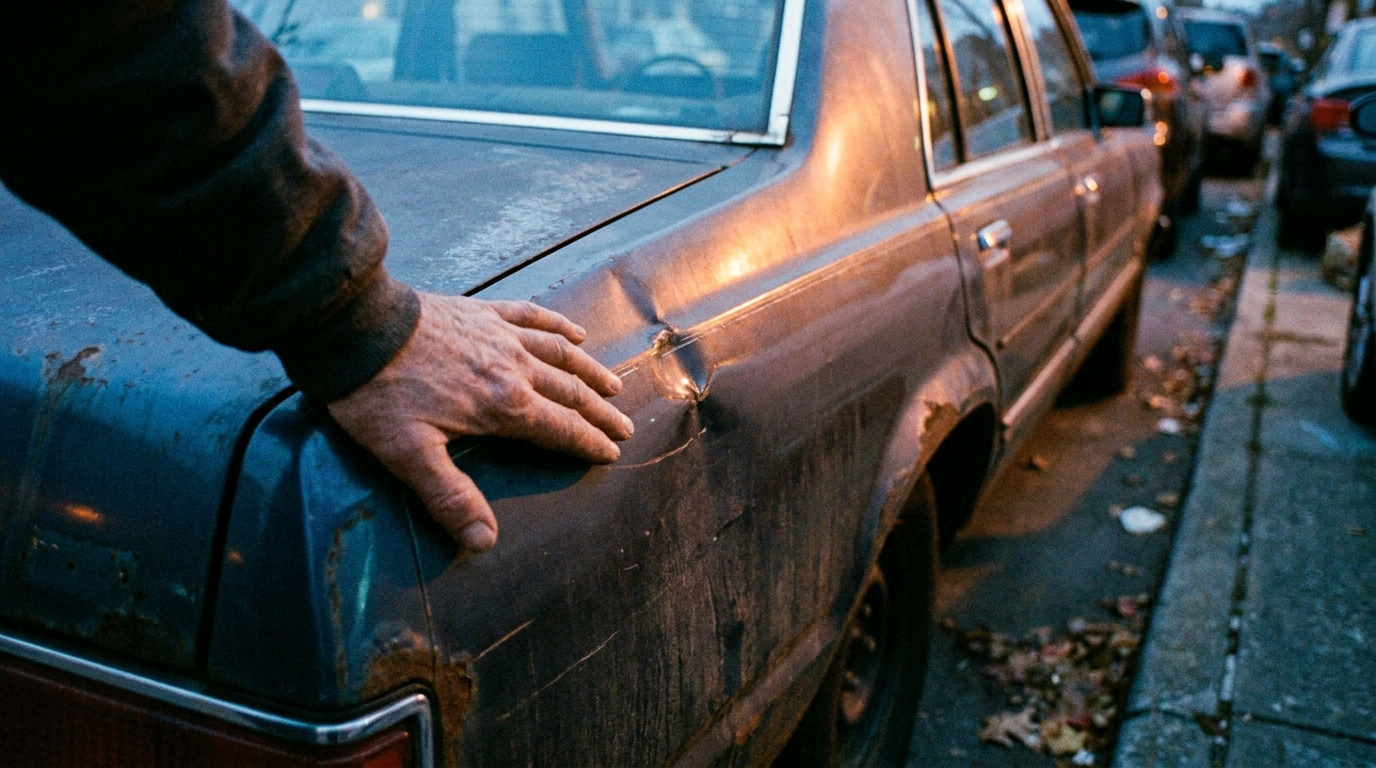
Removing or reducing a dent, scratch, scuff, stone chip or crack. Obvious, and worth stating plainly because it is the edit people rationalise most often.
Correcting a paint mismatch between panels. A mismatch is evidence of repair history. Removing it removes disclosure.
Closing or evening a panel gap. Same reason. Panel gaps are how buyers and inspectors spot previous accident damage.
Editing out rust or bubbling. Never defensible.
Making tyres look newer, cleaner or deeper than they are.
Changing anything on the odometer, badges, compliance plate or registration.
The genuinely grey zone.
This is where honest people disagree, and where you should be most careful.
Heavy exposure lifting that flattens swirl marks and light scratches out of existence. You did not remove anything deliberately. The effect on the buyer is the same as if you had. Treat blown highlights on paint as a red flag in your own work.
Aggressive noise reduction or sharpening. Modern phone processing already does a version of this. Push it further and you start smoothing texture that was carrying information about paint condition.
Lens distortion correction. Fixing barrel distortion is fair. Choosing a focal length that makes a car look longer and lower than it is sits closer to the line than most people realise.
Shooting only in the rain or only at dusk so that condition is hard to read. Not an edit at all, which is exactly why it is worth naming. You can mislead without ever opening an editor.
Why this is a product decision, not just an ethics one
There is a commercial argument here that gets lost in the moralising.
If your photos hide condition, you are not avoiding the conversation about condition. You are moving it to the buyer's driveway, after they have driven forty minutes, at the moment they are most annoyed. That is the single worst place to have it. Handover disputes, wasted inspections and a reputation for surprises all cost more than the enquiries you gained.
Dealers running volume feel this most sharply. A photo pipeline that flatters condition generates more clicks and more no shows. The metric that matters is not enquiries per listing, it is days to sale and complaints per hundred cars.
How Cardabra handles it
We built the constraint into the product rather than into a policy document, because policies get ignored and constraints do not.
The system replaces the environment around the car and leaves the car itself alone. Every dent, scratch, scuff and weathered edge that went in comes out the other side. This is a harder engineering problem than the alternative, not an easier one. Relighting a vehicle convincingly for a new environment means the reflections in the paint, the shadow under the sill and the way light falls across each panel all have to agree with the surroundings you dropped it into, while the surface detail that carries condition stays exactly as photographed. A tool that smoothed everything to a clean finish would have been considerably simpler to build.
On your side of it, that is a photo upload and a background choice. Pricing is per credit, with six free to start.
We know that means our output sometimes looks less polished than a competitor's on the same car. That is the trade we chose, and it is the right one if you intend to still be selling cars to the same suburb in five years.
A test you can apply in three seconds
Before you publish, look at the edited photo and ask: if this buyer stood in front of the actual car right now, what would surprise them?
If the answer is "the background is different", you are fine. Nobody has ever been disappointed to learn a car was photographed in a driveway.
If the answer is anything about the car itself, go back.
If you are comparing tools, our guide to choosing an AI car photo editor in Australia applies exactly this test, and the cost breakdown against a photographer covers what each option runs to in Australian dollars.
Turn your phone snaps into showroom-grade listings.
Upload a photo, pick a background, and Cardabra returns a polished listing image in about 30 seconds.