

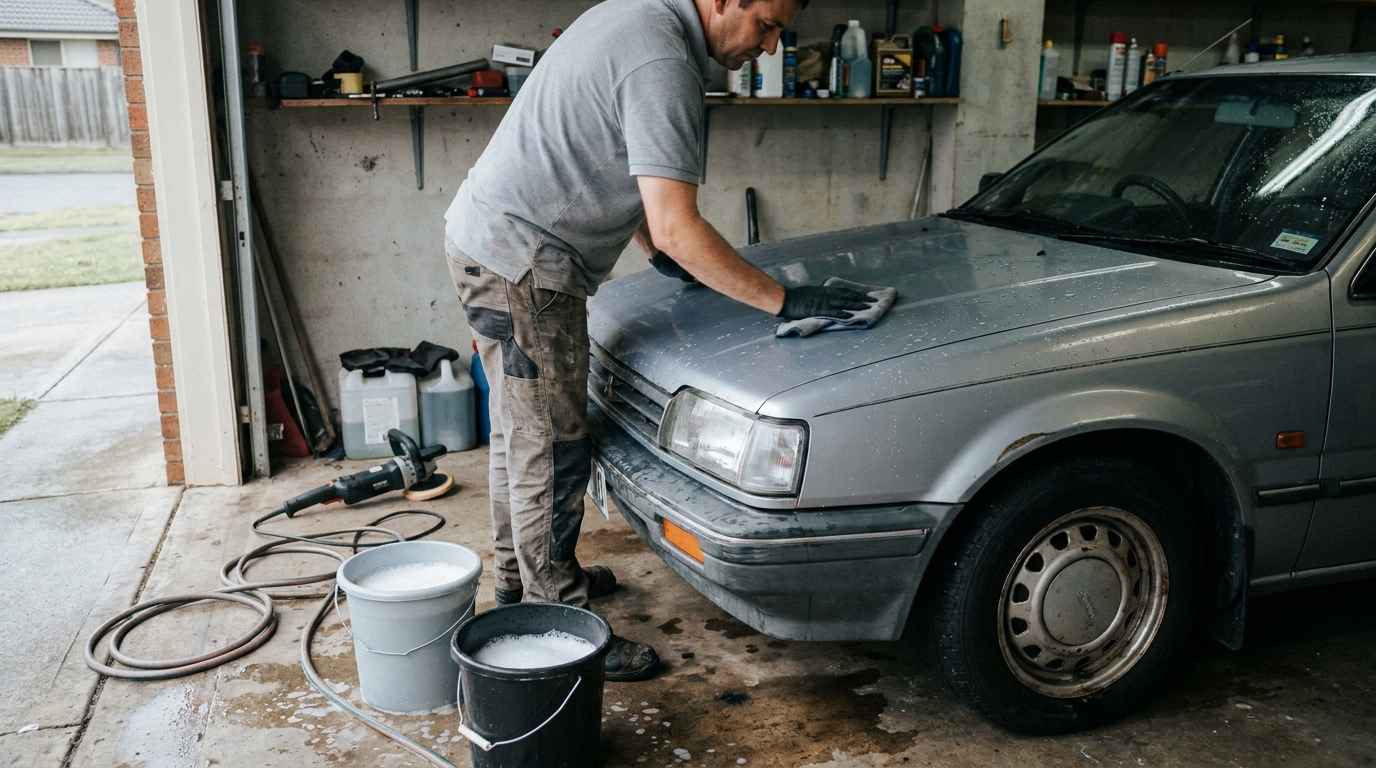
For a detailer, the before and after photo is the whole sales pitch. Nobody books a full paint correction because your logo looks nice. They book because they saw a swirled, chalky bonnet turn into glass and thought, I want that. The good news is that you do not need a photographer to get there. You need a repeatable way to shoot both halves of the story, and an editing habit that makes the work look as good as it is without ever doing the work for you.
That last part matters more for detailers than for anyone else selling online. A car seller who over edits a photo risks an awkward inspection. A detailer who over edits a photo is faking the product itself. Your entire trade is the difference between the before and the after. If editing manufactures any part of that difference, the photo is a lie about your own workmanship, and repeat clients figure that out quickly.
Why the before shot is the one that sells
Most detailers shoot the after with care and grab the before as an afterthought, usually a quick snap in a dark corner of the garage before the machine comes out. That gets the psychology exactly backwards. The after shot has no meaning without a credible before. A spotless car on its own is just a spotless car. A spotless car next to the same car covered in swirl marks and water spots is proof of skill.
So slow down on the before. Shoot it in decent light, in focus, from the same angles you plan to use for the after. Get close on the worst of it: the swirls under direct light, the oxidation on the roof, the stained seat, the wheel caked in brake dust. If the before looks deliberately terrible because it was shot in the dark at a bad angle, viewers sense the trick. A fair, clear before makes the after unarguable.
A simple habit fixes this: photograph the before immediately after the walkaround inspection, while you are already looking closely at every panel. You are documenting condition for your own protection anyway. Those same frames become your marketing.
Match the pair or lose the effect
The transformation only lands if the two photos are obviously the same car in the same place. That means matching four things between before and after: position, angle, framing and light.
Park the car in the same spot for both shots, or mark the ground if the car has to move during the job. Stand in the same place, hold the phone at the same height, and frame the car the same way. Shoot the pair at similar times of day if you can, because a before at midday and an after at golden hour is mostly a photo of nicer light, not nicer paint.
Phones make this easier than it sounds. Take the before, then use it as a reference on screen while lining up the after. Some detailers keep a small checklist of standard angles per job type: front three quarter, bonnet from above, driver seat from the door, one wheel, plus close ups of whatever the job targeted. Our guide to photographing a car with just a phone covers the general technique, and almost all of it applies straight to detailing work.
For interior jobs, light matching matters even more. An interior before shot with the doors closed and an after with all four doors open in sunlight will read as staged. Same doors, same light, same angle.
Editing rules for detailers: one treatment, both photos
Here is the rule that keeps everything honest: whatever you do to one photo, you do to both. Same exposure lift, same crop, same background treatment, same colour balance. The moment the after gets flattering treatment the before did not get, you are editing the transformation instead of presenting it.
What editing can legitimately do for a detailing pair:
- Clean up or replace a distracting background, applied to both frames
- Balance exposure so panels are readable, applied to both frames
- Crop and straighten identically
- Blur the rego plate, which you should do by default on client cars
- Keep colours true to what the client will see when they pick the car up
What editing must never do:
- Remove swirl marks, scratches or oxidation from the after that the polisher did not remove
- Deepen gloss or wet look beyond what the paint actually shows
- Clean digital grime out of an interior shot
- Darken or degrade the before to widen the gap
The test is the same one we apply to listing photos in where the line sits with car photo editing: if the client compared the photo with the car in person, would anything feel different? For a detailer the stakes are doubled, because the client is standing next to the car at handover looking at exactly the panels you photographed.
A phone workflow that fits between jobs
You do not have time to art direct every job, so make the photography part of the job flow rather than an extra task.
- Walkaround inspection, shooting the before as you go. Wide shots first, then the problem areas.
- Note your shooting positions. Two minutes, once.
- Do the work.
- Shoot the after from the same positions, before the car leaves. Once the client drives off, the after shot is gone forever.
- Process the pair identically, blur the plate, and file them by job type.
Background is the one place phones consistently let detailers down. Most detailing happens in driveways, home garages and industrial units, and a stunning paint correction photographed against wheelie bins and shelving looks like a hobby, not a business. This is where a background replacement pass earns its keep. Cardabra was built for exactly this situation: it takes a phone snap and rebuilds the setting to showroom standard while preserving the panel exactly as shot, down to stone chips and swirl marks. That preservation is the point for a detailer. The algorithm is doing sophisticated work separating car from scene, but it deliberately leaves the car itself alone, which means your before keeps its swirls and your after keeps its real finish, just both presented cleanly. You can run a handful of pairs through it on the free tier and judge the result against your own eye.
If you also prepare cars for sale, the same discipline carries over to listing sets, and our used car photo workflow for dealers shows how the routine scales across inventory.
Where the pairs actually earn money
Shot and edited once, a good pair works across every channel an Australian detailer actually uses.
Google Business Profile is the highest value spot and the most neglected. When someone searches detailer near me, profiles with recent, real job photos win the click. Upload pairs regularly, not in one annual dump.
Instagram and Facebook are where pairs perform best as split frames or two slide posts. Post the before first in carousels, because the swipe is the transformation.
Facebook Marketplace and Gumtree matter if you sell detailing as preparation for private sellers. A pair showing what you did to a listing car, with the seller's permission, is the most persuasive ad you can run to that audience.
Your own quote replies close jobs. When someone asks what a full correction costs, a price with two photos attached converts far better than a price alone.
One habit ties it together: caption pairs with what was actually done. Single stage machine polish, four hours, is more credible than transformation Tuesday. The specificity does the selling, and it also protects you, because a pair labelled honestly can never be accused of promising more than the service delivers.
The photos are the proof of work. Shoot both halves like they matter, edit them as a pair, never let the edit do the polishing, and put the results where local customers are already looking.
Turn your phone snaps into showroom-grade listings.
Upload a photo, pick a background, and Cardabra returns a polished listing image in about 30 seconds.